

Pharmaceutical Isolator Market to reach USD 4.13 Billion by 2035 at 10.8% CAGR
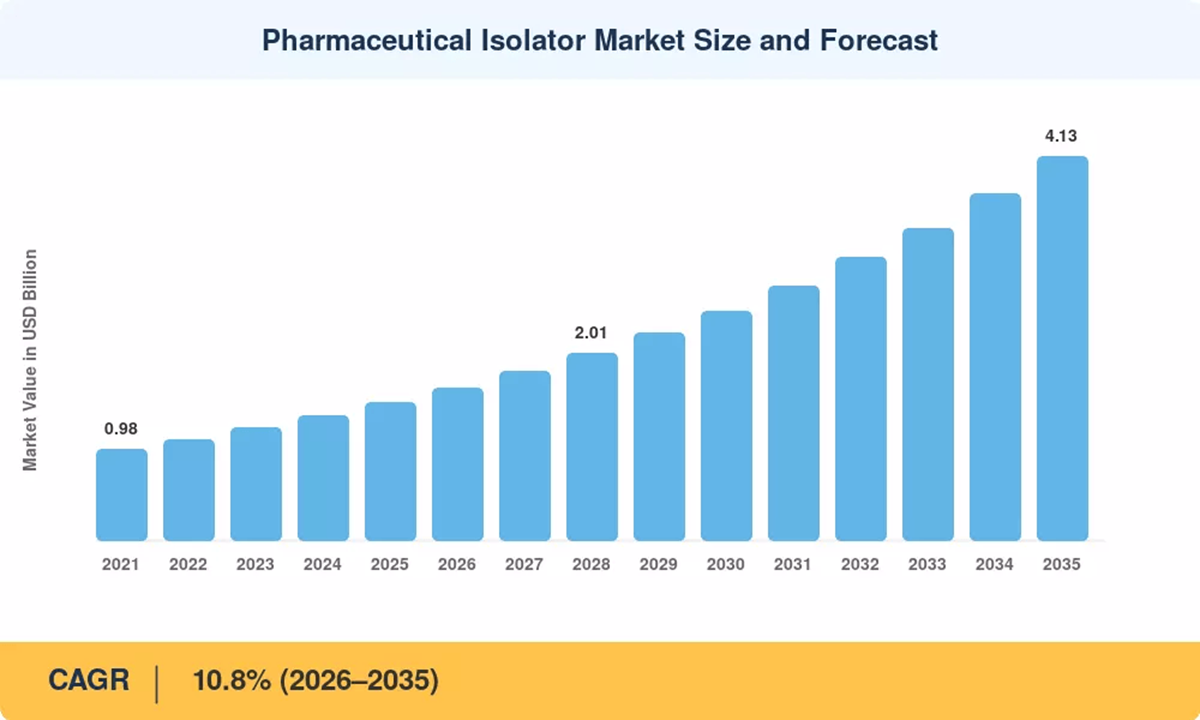
Pharmaceutical Isolator Industry size
Pharmaceutical Isolator Market to Surge from USD 1.66 Billion in 2026 to USD 4.13 Billion by 2035-Powered by Regulatory Tightening, Biologics Pipeline Expansion
NY, CA, UNITED STATES, July 13, 2026 /EINPresswire.com/ -- As per Market Research Future, the global Pharmaceutical Isolator Market size to reach USD 4.13 Billion by 2035 from USD 1.66 Billion in 2026, at a CAGR of 10.8% during the forecast period 2026--2035. The market base was estimated at USD 1.48 Billion in 2025.The 10.8% CAGR---anchored by structural regulatory demand rather than discretionary healthcare spending---is driven by three converging forces: tightening global regulatory frameworks that mandate contamination control strategies for sterile product manufacturing, sustained biologics and biosimilar pipeline expansion that has pulled isolator procurement from optional upgrade into mandatory production infrastructure, and rising high-potency active pharmaceutical ingredient (HPAPI) and antibody-drug conjugate (ADC) manufacturing demand that necessitates containment-grade isolator environments throughout weighing, dispensing, and formulation stages.
National governments and multilateral health organizations are amplifying this momentum. The revised EU GMP Annex 1, which took effect in August 2023, mandates enhanced contamination control strategies for sterile product manufacturing---a regulatory catalyst that has driven capital expenditure toward isolator-based production lines across both established and emerging drug manufacturers.
Request A Free Sample:
https://www.marketresearchfuture.com/sample_request/4683
Key Market Trends & Growth Drivers
Regulatory Tightening as the Primary Demand Catalyst
With the introduction of the contamination control strategy (CCS) requirement in August 2023, the updated EU GMP Annex 1 forced producers to use closed processing facilities. Isolators directly address compliance deficiencies in facilities that previously relied on traditional cleanroom operations. In a similar vein, enhanced barrier isolation is emphasized as a recommended method to reduce operator intervention in critical zones in the FDA's established cGMP guidance on sterile medicinal products made via aseptic processing. According to industry projections, between 2024 and 2028, global cleanroom and isolator retrofit spending might reach USD 2.8 billion due to Annex 1 compliance alone.
The revised EU GMP Annex 1 mandates enhanced contamination control strategies for sterile product manufacturing---a regulatory catalyst that has driven capital expenditure toward isolator-based production lines across both established and emerging drug manufacturers. Legacy open-architecture cleanroom setups---long the industry default---are giving way to closed and restricted-access barrier systems that deliver Grade A environments within smaller footprints and at lower operating costs. Each percentage point of regulatory enforcement intensity translates into measurable procurement volume for isolator systems, and the contamination control strategy embedded in routine GMP compliance makes this driver structurally durable through 2035.
Biologics Pipeline Fueling Aseptic Demand
Approximately 31% of all FDA innovative medicine approvals in 2023 were biologics, and the pipeline is still expanding. The majority of these goods need aseptic fill-finish procedures, where isolators provide a proven benefit over traditional classified settings. Each new commercial biologic or biosimilar usually requires dedicated sterile filling capacity, which translates into continuous isolator procurement cycles for the Pharmaceutical Isolator Market through 2035. The worldwide biologics market exceeded USD 480 billion in 2024.
Extended survival in metastatic cancers and the global expansion of injectable drug manufacturing create a larger prevalent population requiring sustained aseptic processing infrastructure. Longer survival transforms cancer from a rapid-mortality diagnosis into a chronic disease with sustained biologic utilization. Early-adopter health systems report that isolator-based production lines deliver 10--100x lower contamination rates than restricted access barrier systems (RABS) and eliminate dependence on surrounding room classification, converting facilities that previously relied on traditional cleanroom operations into compliant Grade A environments.
HPAPI Manufacturing Driving Containment Demand
High-potency active pharmaceutical ingredients demand occupational exposure limits below 10 µg/m³, necessitating containment-grade isolators throughout weighing, dispensing, and formulation stages. The global HPAPI market grew at roughly 9.5% annually between 2020 and 2024, with antibody-drug conjugates (ADCs) representing a particularly active subsegment. Each new ADC manufacturing suite typically requires two to four containment isolators, creating a predictable multiplier effect on the Pharmaceutical Isolator Market.
The move from open-bench to isolator-based containment---as seen with closed isolator systems accounting for approximately 62% of global revenue---decreases operator exposure risk while increasing regulatory compliance. Contract development and manufacturing organizations (CDMOs) and community cancer clinics are seeing a rising preference for containment-grade isolators due to lower operating costs and higher safety assurance. This safety-driven adoption is expected to open up incremental revenue for the Pharmaceutical Isolator Market in the absence of legacy cleanroom infrastructure. China's 14th Five-Year Plan emphasis on domestic biopharmaceutical self-sufficiency and India's PLI scheme together make advanced containment platforms accessible to more than 900 million previously underserved manufacturing populations.
Ask for Customization:
https://www.marketresearchfuture.com/ask_for_customize/4683
Market Segment Insights
BY TYPE
Closed Isolator Systems: Dominant segment with ~62% revenue share in 2025. Reflecting industry preference for superior containment assurance. Closed isolator systems provide the highest level of environmental separation between the operator and the product, meeting Grade A conditions without reliance on surrounding classified environments. These systems are the default choice for aseptic fill-finish, sterile API handling, and any application where absolute containment is non-negotiable. Pharmaceutical companies investing in new biologics production lines overwhelmingly specify closed systems to future-proof regulatory compliance.
Open Isolator Systems: Fastest-growing type segment at 9.6% CAGR (2026--2035). Driven by non-sterile weighing and dispensing applications. Open Isolator Systems, while offering lower containment assurance, are gaining adoption in less critical process steps such as non-sterile weighing, sampling, and packaging operations. Their lower cost and simpler validation requirements make them attractive for facilities transitioning from open-bench operations, particularly in price-sensitive emerging markets.
BY APPLICATION
Aseptic Isolators: Dominant application segment with ~45% revenue share in 2025. Approximately 31% of all FDA innovative medicine approvals in 2023 were biologics, making aseptic fill-finish a near-universal component of biologics manufacturing pathways. The inherent sterility requirements of injectable drug subtypes drive sustained demand for aseptic isolator systems.
Containment Isolators: Fastest-growing application segment at 12.1% CAGR (2026--2035). Reflecting improved HPAPI and ADC production that extends the window for containment-grade equipment. The ADC therapeutic class alone has over 100 candidates in late-stage clinical development globally as of 2025, and each manufacturing process requires containment-grade equipment for handling cytotoxic payloads.
BY END USER
Pharmaceutical and Biotechnology Companies: Largest segment with ~68% share in 2025. Comprehensive commercial manufacturing requirements and regulatory mandates dominate volume. Pharmaceutical and biotechnology companies represent the core customer base for the Pharmaceutical Isolator Market, accounting for the majority of equipment procurement driven by commercial manufacturing requirements and regulatory mandates. Large pharma companies increasingly standardize on isolator-based production for new facility builds, while biotech firms entering commercial manufacturing adopt isolators to meet FDA and EMA sterility expectations from inception.
Research Laboratories: Fastest-growing end-user segment at 11.5% CAGR (2026--2035). Outpatient shift and R&D activity toward potent compounds drive demand as laboratory-grade isolators reduce the need for full-scale cleanroom infrastructure. Research laboratories are growing as an end-user segment as R&D activity shifts toward potent compounds and advanced therapies that demand controlled handling environments, even at bench and pilot scale.
Academic & Research Institutes: 7.4% market share in 2025. Cell and gene therapy research sustains residual demand.
Hospitals: Growing segment at 9.3% CAGR (2026--2035). USP <797> and USP <800> standards increasingly require isolator use for hazardous drug compounding and sterile preparation.
Read Detailed Insights:
https://www.marketresearchfuture.com/reports/pharmaceutical-isolator-market-4683
Regional Outlook
North America -- Dominant Market (~38% Share, 2025)
The United States generates approximately 78% of North American Pharmaceutical Isolator Market revenue, driven by the FDA's emphasis on contamination risk reduction in sterile injectable production, commercial insurance coverage of isolator-based manufacturing as standard practice, and broad procurement of aseptic fill-finish isolators---a single policy ecosystem that converted a cleanroom-dominated market into one with a structural isolator adoption tail. FDA updated draft guidance on sterile drug products manufacturing, released in September 2024, reinforces preference for closed processing systems, including isolators for aseptic operations. The US dominates through a combination of high per-facility spending, robust biologics pipeline, and rapid isolator adoption in academic medical centers and commercial manufacturing.
Canada contributes through provincial biologics manufacturing incentives at 9.2% CAGR, while Mexico is growing at steady pace on nearshoring pharma production at USD 0.03 Billion in 2025. North America's leadership rests on regulatory depth and the structural biologics segment created by expanded FDA compliance mandates and value-based manufacturing contracts.
Europe -- Second Largest (~29% Share, 2025)
Europe's Pharmaceutical Isolator Market reflects divergent national strategies---Germany leads regionally with precision pharma manufacturing heritage, contributing ~24% of regional revenue, while the UK has emerged as a center for cell and gene therapy production requiring specialized isolator configurations at 11.3% CAGR. France contributes ~18.5% of regional share through biosimilar production investments. Italy contributes ~12% on pharmaceutical machinery export cluster strength. Spain is growing at 9.8% CAGR on generic drug manufacturing investment.
Harmonization pressure from the EU Pharmaceutical Strategy is gradually narrowing these differences, lifting baseline demand across the region. The European Commission's Pharmaceutical Strategy mandates equitable access to advanced manufacturing technologies, including isolator-based production across all member states. The Nordic countries hold ~7.4% of regional share on centralized procurement efficiency. Russia contributes 8.2% CAGR on domestic pharma self-sufficiency policy. Centralized health technology assessment bodies---NICE, G-BA, and HAS---have progressively widened reimbursement for advanced manufacturing across therapeutic categories.
Asia-Pacific -- Fastest-Growing Region (12.4% CAGR, 2026--2035)
Asia-Pacific is the engine of the Pharmaceutical Isolator Market. China holds the largest regional share with ~36% of regional revenue, driven by the 14th Five-Year Plan emphasis on domestic biopharmaceutical self-sufficiency---instantly extending advanced manufacturing coverage to over 1.3 billion production populations. India is growing at 13.6% CAGR on the back of PLI scheme and vaccine manufacturing scale. Japan contributes USD 0.06 Billion through NHI pricing for advanced therapy manufacturing at steady pace. South Korea is growing at 12.8% CAGR on biosimilar export-oriented production.
ASEAN economies hold ~9% of regional share on emerging CDMO destinations. The rest of Asia-Pacific is growing at 10.2% CAGR on diversified pharmaceutical growth. The region's combined contribution anchors the global volume base for isolator demand. Asia-Pacific represents the highest-growth opportunity, driven by a confluence of rising biologics manufacturing, urbanization, and government investment in pharmaceutical infrastructure.
Middle East & Africa -- Emerging Opportunity (8.7% CAGR, 2026--2035)
The Middle East & Africa is bifurcated between well-funded Gulf states and resource-constrained Sub-Saharan nations. Saudi Arabia leads the region with Vision 2030 healthcare manufacturing cluster development, contributing ~31% of regional share---NEOM health cluster and the UAE's free-zone pharma hub development have created pockets of excellence for pharmaceutical manufacturing. The UAE is growing at 10.4% CAGR on free-zone pharmaceutical manufacturing strategy. South Africa contributes USD 0.01 Billion on vaccine self-sufficiency initiatives.
Egypt is growing at 8.9% CAGR on generic manufacturing capacity growth. WHO-sponsored technology transfer agreements underpin demand across the rest of the region. Validation complexity and extended commissioning timelines of 6--12 months create friction points for manufacturers facing urgent production timelines. These challenges lead to procurement delays and facility reluctance to initiate modern isolator adoption, indirectly narrowing the Pharmaceutical Isolator Market addressable population.
South America -- Growing Presence (USD 0.09 Billion, 2025)
Brazil anchors South America's Pharmaceutical Isolator Market at ~58% of regional revenue, with government-backed vaccine production programs at institutions like Fiocruz and Instituto Butantan providing a stable demand floor that smooths regional forecasts. Access to advanced containment platforms remains limited by capital intensity barriers, though the Brazilian Nuclear Energy Commission has initiated domestic production feasibility studies. Argentina is growing at 9.4% CAGR on biopharmaceutical export growth.
The rest of South America is growing steadily on Pan-American Health Organization programs. South America's procurement runs largely through public health systems, which pool demand to secure competitive pricing. The region's stable demand base supports manufacturer volume planning even as per-unit tender prices compress margins. Biosimilar and generic production expansion remains a structural driver---over 50 new product launches projected between 2025 and 2030 sustain steady demand for aseptic fill-finish isolators.
Competitive Landscape and Recent Developments
The Pharmaceutical Isolator Market displays medium concentration, with the top five companies holding an estimated 45--52% combined revenue share. The Herfindahl-Hirschman Index sits in the 1,400--1,600 range, reflecting a mix of European-headquartered specialists and diversified pharmaceutical equipment conglomerates. Patent-protected customization and integrated validation services sustain competitive moats for first-movers, though modular platform standardization is gradually fragmenting bespoke segments.
The competitive landscape is stratified between aseptic isolator pioneers serving global biologics manufacturing markets, containment specialists capturing HPAPI and ADC tenders, and modular platform developers consolidating the standard isolator segment.
KEY COMPANIES AND RECENT MILESTONES
SKAN AG (March 2025): Launched the next-generation isolator platform featuring integrated robotic vial handling and reduced bio-decontamination cycle times to under 25 minutes, targeting high-throughput biologics manufacturing. Premium integration and Swiss engineering reinforce the pioneer in aseptic isolator positioning, holding ~10--14% of global Pharmaceutical Isolator Market revenue.
Getinge AB (2024--2025): DPTE transfer, containment, and aseptic systems reinforce the broad sterile workflow ecosystem positioning, holding ~8--12% of global revenue. The company benefits from the structural biologics tail created by expanded aseptic processing infrastructure investment.
Comecer S.p.A. (November 2024): Expanded its VaxISO product line with a new downstream processing isolator designed for mRNA vaccine formulation and fill-finish operations. Nuclear and pharma isolator specialization reinforces the radiopharmaceutical and vaccine niche positioning, holding ~7--10% of global revenue.
Fedegari Group (2024--2025): Integrated isolator-autoclave systems reinforce the sterilization process integration positioning, holding ~5--8% of global revenue.
Dec Group (April 2024): Introduced an enhanced powder transfer system compatible with high-containment isolators rated for OEL below 1 µg/m³, addressing ADC manufacturing requirements. High-potency compound specialization reinforces the containment-grade positioning, holding ~4--7% of global revenue.
Future Outlook: 2026--2035
By 2030, precision radiopharmaceutical theranostics and personalized medicine will become the operating system of pharmaceutical manufacturing. The convergence of single-use bioprocessing with isolator design presents a high-growth opportunity. Pre-sterilized, gamma-irradiated isolator bags and disposable transfer sleeves reduce decontamination cycle times and eliminate cleaning validation burden.
Several equipment manufacturers are investing in modular disposable isolator platforms targeting clinical-scale manufacturing. By 2030, an estimated 40% of newly diagnosed metastatic prostate cancer patients will undergo PSMA-PET staging followed by matched radioligand therapy, creating a diagnostic-therapeutic demand loop that requires shielded, contained isolator environments for both hot-cell operations and final dispensing.
More Related Research Insights:
https://www.marketresearchfuture.com/reports/abortion-drug-market-40902
https://www.marketresearchfuture.com/reports/lymphocytic-choriomeningitis-market-38925
https://www.marketresearchfuture.com/reports/moist-wound-dressing-market-43427
https://www.marketresearchfuture.com/reports/self-injection-device-market-43501
https://www.marketresearchfuture.com/reports/clinical-ehr-market-41772
https://www.marketresearchfuture.com/reports/stomach-cancer-treatment-market-67899
https://www.marketresearchfuture.com/reports/advanced-authentication-in-healthcare-industry-market-42686
https://www.marketresearchfuture.com/reports/medical-devices-cuff-market-43340
https://www.marketresearchfuture.com/reports/medical-walkers-market-32549
https://www.marketresearchfuture.com/reports/urodynamics-equipment-disposables-market-40152
Larry Wilson
WantStats Research And Media Pvt. Ltd.
+1 855-661-4441
email us here
Visit us on social media:
LinkedIn
Facebook
YouTube
X
Legal Disclaimer:
EIN Presswire provides this news content "as is" without warranty of any kind. We do not accept any responsibility or liability for the accuracy, content, images, videos, licenses, completeness, legality, or reliability of the information contained in this article. If you have any complaints or copyright issues related to this article, kindly contact the author above.
