

High Throughput Screening Market to reach USD 70.18 Billion by 2035 at 10.42% CAGR
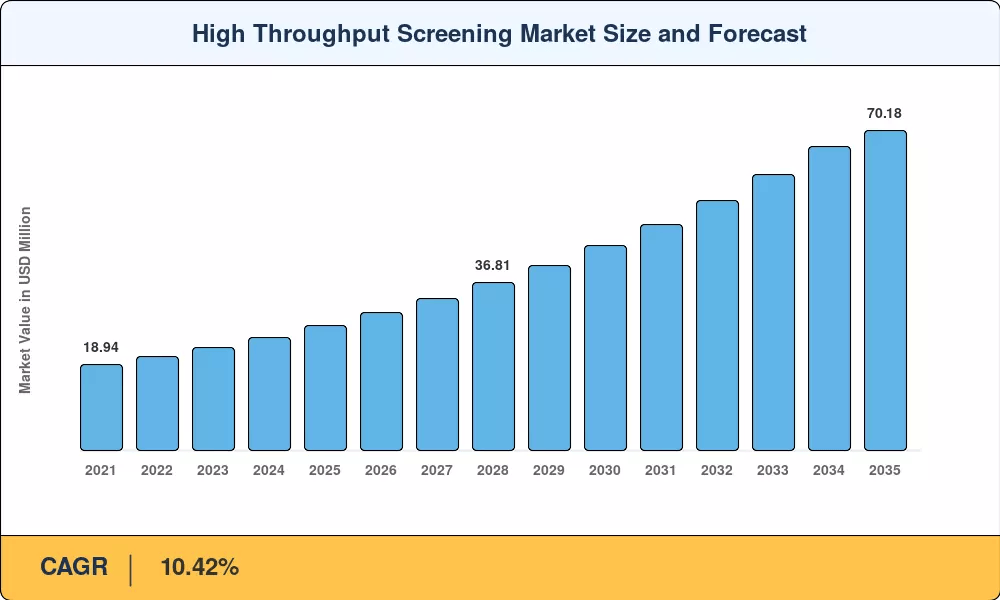
High Throughput Screening Market Size
High Throughput Screening Market to Surge from USD 30.21 Billion in 2026 to USD 70.18 Billion by 2035 — Powered by AI-Enabled Automation, Precision Medicine R&D
NY, CA, UNITED STATES, June 8, 2026 /EINPresswire.com/ -- As per Market Research Future, the global High Throughput Screening Market size is projected to reach USD 70.18 Billion by 2035 from USD 30.21 Billion in 2026, at a CAGR of 10.42% during the forecast period 2026–2035. The market base was estimated at USD 27.42 Billion in 2025.The 10.42% CAGR is anchored by three converging structural forces: the rapid integration of AI and machine learning directly into screening workflows, sustained expansion of pharmaceutical R&D budgets concentrated in precision oncology and rare-disease discovery, and accelerating regulatory acceptance of non-animal testing alternatives following the FDA Modernization Act 2.0. Automated compound library testing has transitioned from premium capability to expected baseline, and the entire discovery stack is being rebuilt around this assumption.
Venture capital has validated the trajectory decisively — microfluidic ultra-high-throughput screening (uHTS) startups attracted over USD 1.2 billion in disclosed funding across 2023–2025. Simultaneously, CDMOs are emerging as the fastest-growing end-user segment at a 12.62% CAGR, as large pharmaceutical sponsors increasingly outsource target-based hit identification to specialized partners with scale and advanced biochemical assay platforms.
Request A Free Sample: https://www.marketresearchfuture.com/sample_request/1280
Key Market Trends & Growth Drivers
AI-Enabled Screening Automation
Machine learning now sits directly inside the screening workflow rather than beside it. Platforms pairing automated compound library testing with predictive hit-ranking algorithms have dramatically compressed hit-to-lead timelines, reducing overhead costs of high-throughput screening assays. The NIH Strategic Plan for Data Science prioritizes federal infrastructure funding for AI software sustainability and data-driven discovery tools, pulling smaller research organizations into the automation tier. This driver contributes an estimated 24% impact on overall market CAGR — the single largest growth catalyst.
Precision Medicine R&D Expansion
Biopharma spending on targeted therapeutics continues to rise, and target-based hit identification is the discovery engine behind it. Industry R&D outlays remain heavily concentrated around complex oncology and rare-disease indications, with leading pharmaceutical firms channeling large portions of multi-billion-dollar budgets to advance late-phase pipelines. This capital flows directly into biochemical assay platforms capable of profiling thousands of molecular targets. The European Commission’s Horizon Europe Cluster 1 (Health) framework, backed by a multi-billion-euro allocation through 2027, further reinforces infrastructure demand across the continent.
Three-Dimensional and Physiologically Relevant Assays
Flat monolayer cultures are giving way to organoids, spheroids, and tissue-mimetic systems that predict in vivo response far more reliably. This shift raises the value of high-content microplate reader systems capable of imaging complex 3D structures. The FDA Modernization Act 2.0, which formally recognized non-animal alternatives, has pushed laboratories to adopt these advanced assay formats faster than originally projected. 3D cell culture and high-content platforms are growing at a 10.84% CAGR through 2035.
Strategic Outsourcing to CDMOs
CDMOs represent the fastest-growing end-user segment in the High Throughput Screening Market at a 12.62% CAGR. Sponsors increasingly outsource screening work to specialized partners offering scale, advanced biochemical assay platforms, and geographic proximity to emerging discovery ecosystems. Tecan Group’s May 2025 strategic partnership with a CDMO network to deploy standardized automated screening workflows across multiple sites exemplifies this structural shift.
Ask for Customization: https://www.marketresearchfuture.com/ask_for_customize/1280
Market Segment Insights
BY TECHNOLOGY
Cell-based assays remain the backbone of the High Throughput Screening Market, commanding a dominant 41.2% share in 2025. Their staying power lies in delivering biologically meaningful readouts that purely biochemical formats cannot — drug candidate screening assays built on living cells better predict therapeutic response, keeping this category entrenched as the default discovery format. Ultra-high-throughput screening systems contributed an estimated USD 4.6 billion in 2025 revenue, driven by the relentless demand for speed and scale in early-stage compound library testing.
Lab-on-a-chip and microfluidic platforms are the fastest-growing technology segment, advancing at an 11.31% CAGR through 2035. Nanoliter-scale assays slash reagent consumption and reduce footprint, making high-throughput capability accessible to smaller labs and CDMOs that cannot justify traditional system costs. Label-free technology, generating USD 3.1 billion in 2025, is gaining traction in assay sensitivity applications where fluorescent tags would alter target behavior. Meanwhile, 3D cell culture and high-content imaging platforms are growing at a 10.84% CAGR, propelled by the FDA Modernization Act 2.0’s formal recognition of non-animal alternatives and the shift toward organoid- and spheroid-based systems that predict in vivo response with far greater fidelity than flat monolayer cultures.
BY APPLICATION
Primary and secondary screening dominate application revenue with a 49.7% share, representing the unavoidable first filter of any discovery campaign. Automated compound library testing at this stage processes millions of compounds, making it indispensable regardless of therapeutic area or screening technology. Target identification generated USD 5.8 billion in 2025, underpinned by precision medicine pipelines that require deep molecular characterization before hit-to-lead progression.
Toxicology and ADME applications are the fastest-growing segment at a 12.74% CAGR, driven directly by regulatory momentum behind non-animal safety assessment. As the FDA and EMA expand acceptance of alternative testing methods, laboratories are investing ahead of fuller mandates to avoid costly retrofits later. Hit-to-lead optimization, valued at USD 4.2 billion in 2025, continues to benefit from AI-guided compound prioritization tools that compress the refinement cycle from months to weeks.
BY END USER
Pharmaceutical and biotechnology companies anchor the High Throughput Screening Market as the largest end-user group, accounting for 44.9% of revenue in 2025. These organizations run extensive in-house screening operations to feed proprietary pipelines concentrated in oncology, rare disease, and neuroscience — areas where biomarker-stratified hit identification is now standard practice.
CDMOs are the fastest-growing buyer segment at a 12.62% CAGR, as sponsors increasingly outsource target-based hit identification to specialized partners capable of delivering scale and geographic proximity to emerging discovery ecosystems. Academic and research institutes generated USD 5.4 billion in 2025, sustained by federal grant pipelines and national genomics programs that fund foundational discovery infrastructure. Contract research organizations (CROs) contributed USD 6.1 billion in 2025, serving as the operational backbone for mid-sized sponsors seeking discovery-as-a-service models that convert heavy capital expense into predictable operating costs.
Read Detailed Insights: https://www.marketresearchfuture.com/reports/high-throughput-screening-market-1280
Regional Outlook
North America — Dominant Market (~36.8% Share, 2025)
The United States generates approximately 81.4% of North American High Throughput Screening Market revenue, driven by dense biopharma clusters, NIH funding pipelines, and FDA modernization policies that reward advanced assay adoption. Canada’s strength lies in university-linked research clusters at a 12.7% regional share, while Mexico is emerging as a near-shore CDMO hub serving North American sponsors. The region’s AI screening platform investment and CDMO scale-up capacity cement its leadership position through the forecast period.
Europe — Second Largest (USD 7.9 Billion, 2025)
Europe’s market is shaped decisively by regulation. The EU’s progressive stance on non-animal testing and sustainable laboratory practice has pushed laboratories toward advanced cell-based and 3D assay systems faster than commercial pressure alone would dictate. Germany leads with 24.6% of regional share, anchored by its pharmaceutical manufacturing base, while the UK contributes 19.8% through world-class genomics and discovery research. The European Commission’s Horizon Europe Cluster 1 allocation through 2027 reinforces infrastructure demand across all member states.
Asia-Pacific — Fastest-Growing Region (12.85% CAGR, 2026–2035)
Asia-Pacific is the growth engine of the High Throughput Screening Market, with India growing at 14.6% CAGR and China at 13.9% CAGR — both fueled by national biotech incentive programs and rapid CDMO capacity expansion that draws screening volume from Western sponsors. Japan contributes a mature, stable revenue base, while South Korea’s government-backed precision medicine funding accelerates platform adoption at 11.4% CAGR. The region accounted for 24.1% of global revenue in 2025.
Middle East & Africa — Emerging Opportunity (Policy-Driven Growth)
Saudi Arabia’s Vision 2030 diversification agenda channels capital into life-sciences research infrastructure (31.2% of regional share), while the UAE positions itself as a regional biotech hub with 27.5% regional share. South Africa retains the continent’s most developed academic screening capacity. The Middle East & Africa region represented 3.8% of global revenue in 2025, with policy-backed momentum expected to accelerate through 2035.
South America — Growing Presence (USD 1.76 Billion, 2025)
Brazil dominates South American activity with USD 0.96 billion in estimated 2025 revenue, supported by a growing clinical research sector and rising pharmaceutical investment. Adoption of biochemical assay platforms is concentrated in major research universities and a small number of well-funded private laboratories. Argentina’s academic discovery programs represent an emerging secondary hub, growing at a 13%+ CAGR.
Competitive Landscape and Recent Developments
The High Throughput Screening Market is moderately concentrated, with an estimated Herfindahl-Hirschman Index in the 900–1,100 range and a top-five revenue share near 48%. The structure leaves room for specialized microfluidic and informatics players to compete alongside diversified instrument leaders, producing a landscape best characterized as moderately fragmented with active technology refresh cycles.
The competitive landscape is stratified between large-portfolio integrators controlling end-to-end workflow platforms, mid-sized specialty firms focused on detection and analytics niches, and AI-native disruptors reshaping discovery economics through data monetization and SaaS models.
KEY COMPANIES AND RECENT MILESTONES
Thermo Fisher Scientific (March 2024): Launched an AI-integrated high-content screening platform aimed at compressing hit-identification timelines, signaling intensified competition in automated discovery. Estimated revenue share: ~13–16% of global High Throughput Screening Market.
Danaher / Beckman Coulter (December 2023): Completed the USD 5.7 billion acquisition of Abcam plc to expand life sciences capability in protein research tools and antibodies, reinforcing Danaher’s automation and workflow scale positioning. Estimated revenue share: ~10–13%.
Agilent Technologies (September 2024): Released a label-free biochemical assay platform targeting target-based hit identification in oncology discovery, reinforcing its detection and analytics focus. Estimated revenue share: ~8–11%.
Revvity (Formerly PerkinElmer, Continuous 2024): Continuously expanded its high-content portfolio by integrating Opera Phenix Plus and Operetta CLS systems with advanced 3D image analysis software modules optimized for organoids and spheroids. Estimated revenue share: ~7–10%.
Tecan Group (May 2025): Announced a strategic partnership with a CDMO network to deploy standardized automated screening workflows across multiple sites. Estimated revenue share: ~5–8%.
Sartorius AG (February 2025): Introduced a live-cell screening system designed for sustainable, low-reagent operation, addressing green-lab procurement trends. Estimated revenue share: ~2–4%.
Future Outlook: 2026–2035
By 2030, self-optimizing platforms are expected to design, run, and interpret assay campaigns with minimal human intervention, using reinforcement learning to prioritize promising chemical space. Autonomous screening operations will become the competitive baseline rather than a differentiator. Simultaneously, decentralized and miniaturized screening via microfluidic and lab-on-a-chip systems will push capability outward — into smaller labs, CDMOs, and point-of-research settings — democratizing access well beyond large pharmaceutical campuses.
Instrument sales alone no longer define vendor success. Reagents, consumables, software subscriptions, and managed services now drive lifetime customer value, and providers winning share are converting one-time hardware buyers into long-term platform subscribers. This shift mirrors the broader life-science tools sector’s pivot toward recurring revenue, creating SaaS-like economics from screening data monetization. The next decade will favor providers who fuse biochemical assay platforms with predictive analytics, building recurring-revenue streams that decouple growth from hardware sales cycles.
Environmental reporting is reshaping lab procurement. Reduced reagent volumes, lower energy consumption, and the regulatory shift away from animal testing align sustainability goals with the economics of advanced screening. Buyers increasingly weigh ESG performance alongside throughput when selecting biochemical assay platforms — a convergence that accelerates adoption of next-generation cell-based and microfluidic systems through 2035.
More Related Research Insights:
https://www.marketresearchfuture.com/reports/high-content-screening-market-33837
https://www.marketresearchfuture.com/reports/drug-discovery-services-market-5870
https://www.marketresearchfuture.com/reports/laboratory-automation-market-11830
https://www.marketresearchfuture.com/reports/cell-viability-assays-market-6391
https://www.marketresearchfuture.com/reports/drug-screening-market-20685
https://www.marketresearchfuture.com/reports/bioinformatics-market-2265
https://www.marketresearchfuture.com/reports/genomics-market-12283
https://www.marketresearchfuture.com/reports/microfluidic-devices-market-954
https://www.marketresearchfuture.com/reports/precision-medicine-market-925
Larry Wilson
WantStats Research And Media Pvt. Ltd.
+1 855-661-4441
email us here
Visit us on social media:
LinkedIn
Facebook
YouTube
X
Legal Disclaimer:
EIN Presswire provides this news content "as is" without warranty of any kind. We do not accept any responsibility or liability for the accuracy, content, images, videos, licenses, completeness, legality, or reliability of the information contained in this article. If you have any complaints or copyright issues related to this article, kindly contact the author above.
